MinVerse: The Future of Haptic Interaction – Exclusive Interview
In an exclusive interview with GizmoCrowd, Haply co-founder Colin Gallacher explains what makes the MinVerse a game-changer: real-time force feedback that lets users physically feel and manipulate virtual objects. The conversation covers how the technology works, its use cases, community-driven development, and where haptics goes next.
Originally published on haply.co — the canonical version of this article.
A device you have to feel to believe
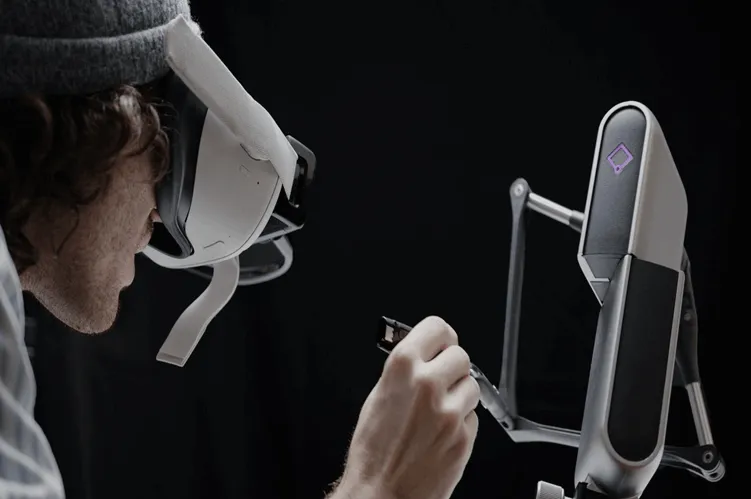
Imagine sculpting digital clay and actually feeling every ridge and groove beneath your fingertips, or designing furniture by touching virtual materials before they exist in the real world. That is the promise of the MinVerse, the haptic device that won CES 2025 Best of Innovation in the Metaverse and XR categories. In an exclusive interview with Michael of GizmoCrowd, Haply co-founder Colin Gallacher explained why the device is a game-changer: unlike conventional 3D mice, VR controllers, or graphics tablets, the MinVerse provides real-time force feedback, letting users physically feel and manipulate virtual objects with an unprecedented level of control — “a monumental leap forward – one that has to be felt to be believed.”
How the force feedback works
Gallacher described how the MinVerse uses precision actuators and haptic/force-feedback algorithms to simulate touch in virtual and 3D environments, adapting intelligently to different materials in real time. Rather than sending a simple vibration, the device actively resists, assists, or adapts to movement based on the properties of the object: quicksand feels smooth when moved through slowly but hardens when pushed fast; velvet is softer brushed one way than the other; magnets pull when close and push back when pulled away; jelly-like substances push back with increasing force the more they are compressed.
Use cases across industries
The interview explored the use cases Gallacher is most excited about: sculpting in Blender or ZBrush while feeling the density of the material; building game environments by physically placing objects and adjusting terrain; controlling a drone remotely while sensing wind, proximity, and terrain; XR gaming where players feel a bowstring’s tension or a heavy door’s weight; and education and accessibility, where students physically interact with digital models and people with motor impairments gain new ways to engage with digital spaces through force-feedback controls.
Community-driven from day one
Community involvement has been at the heart of the MinVerse since its very first video asked, “What would it look like if we did this?” Gallacher described bringing the audience along from early prototypes through design decisions, beta testing, and feature rollouts — and the challenge of marketing a touch-based experience through a visual medium. The MinVerse ships with open-source APIs and compatibility with tools like Blender, RoboDK, and HARP.
What’s next for MinVerse and haptics
Looking ahead, Haply is working on new software integrations (ZBrush, SolidWorks, Maya, Unity), accessories like 2D mouse adapters, VR headset handle adapters, and new VerseGrips, plus real-world demos throughout 2025. Gallacher also tied haptics to the bigger picture raised by NVIDIA CEO Jensen Huang’s CES 2025 emphasis on Physical AI: force feedback has huge potential for training humanoid robots, enhancing Large Behavioral Models (LBMs), and advancing spatial computing. The goal: make haptic technology as ubiquitous and essential as the mouse or touchscreen.
▶ Watch: A 2D-to-3D Haptic Mouse for the Digital Age: The MinVerse by Haply Robotics
Read the original interview
The campaign is live on Kickstarter. This article has been condensed for relevance. Find the original article on GizmoCrowd.